
Friday, 13 June 2014


Thursday, 17 October 2013
Caritas Austria President Mr. Franz Küberl Lauds SAFBIN Efforts
“Smallholder farmers can achieve food security and
self-sufficiency with their traditional and innovative agriculture practices
that have the potential to solve the adverse effects of climate change”.
Caritas Austria president Mr. Franz Küberl observed this while addressing the
farmers’ fair organised by Caritas India in Satna on 12 October. The conclave
of smallholder farmers who are engaged in adaptive agriculture practices in
three districts of Madhya Pradesh was organised as part of the ‘Strengthening Adaptive
Farming in Bangladesh, India and Nepal’ (SAFBIN) programme. Implemented by
Caritas India, SAFBIN is jointly supported by European Union (EU) and Caritas
Austria.
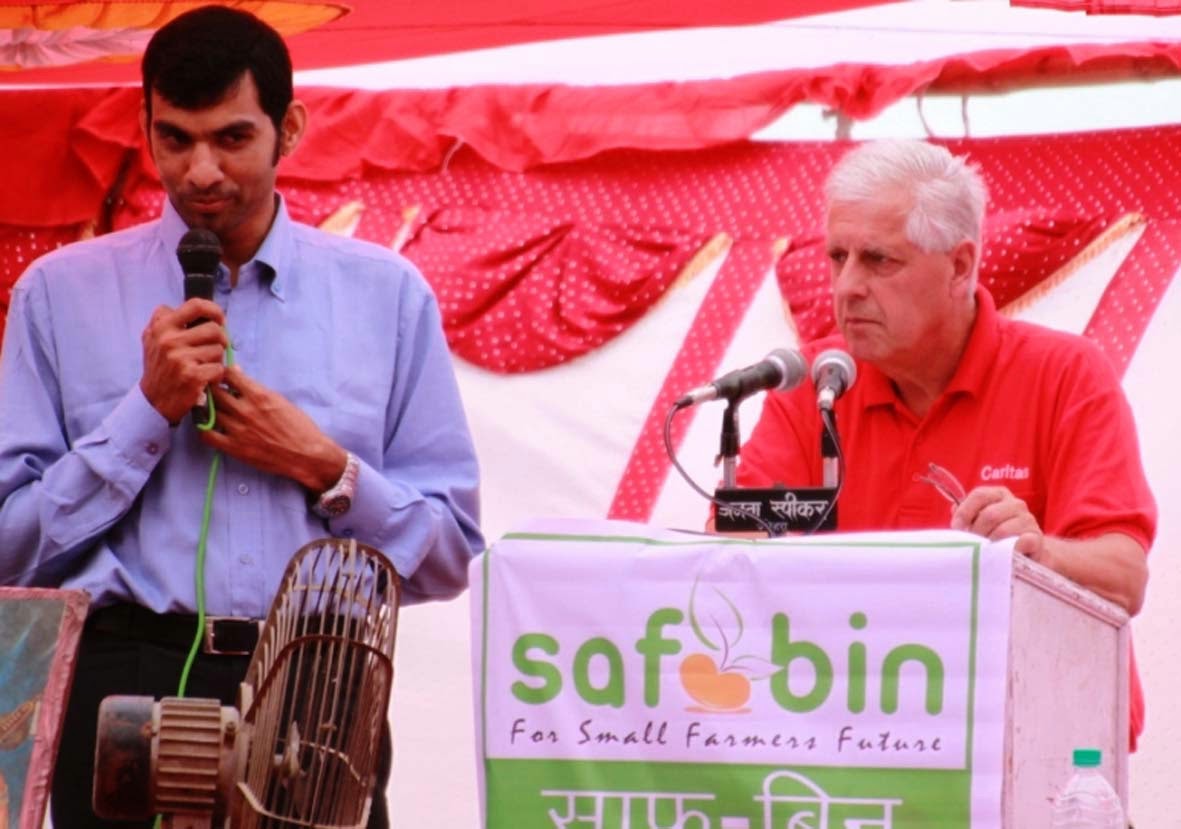 |
| Mr. Franz addressing the smallholder farmers' fair |
Citing the severity of agriculture losses suffered by farmers
across the globe due to climate changes, Mr. Franz underscored the need of
identifying local solutions for making smallholder farming systems more viable
and profitable. “Developing an effective agriculture practice based on the
synthesis of modern agriculture methods and local wisdom holds key to the
success in the efforts to achieve food security of smallholder farmers”, Mr.
Franz said. He appreciated Caritas India for leading the campaign for
protecting the livelihood and food security of smallholder farmers in the
region. “Quality of life of smallholder farmers is dependent on the
adaptability of farming system and the immunity of smallholder farming systems
to the vagaries of climate. If we do not make local farming systems robust and
sustainable, we will live in poverty which will only push our future generation
into greater poverty”, Mr. Franz added.
The farmers’ fair was organised for facilitating the
exchange of learning and experience of smallholder farmers who are implementing
various trial combinations of paddy, wheat and black gram. Over 400 smallholder
farmers from Mandla, Sagar and Satna districts attended the fair and shared the
learning and experiences emerging from the three rounds of trials. The farmers
fair also showcased the innovations developed by farmers, various trial design
illustrations and farm produces.
 |
| Mr. Christoph addressing the function |
Mr. Christoph Schweifer, General Secretary of Caritas
Austria, spoke on the occasion and shared his experiences about the general
struggles of smallholder farmers. “Smallholder farmers need to have thorough
understanding about the various dimensions of climate change and its effects”,
Mr. Christoph said. Developing sustainable solutions for combating the
ramifications of climate change on agriculture is possible only when
communities work concertedly and purposefully. Modern agriculture has made
creditable advancements in the direction of mitigating the detrimental climate
change effects on agriculture. He expressed hope that SAFBIN will emerge as a
platform of communities for technology dissemination which will eventually lead
to greater well-being of smallholder farmers.
Mr. Manfred Aichinger, Project Manager of Caritas Austria shed light on
the symbiotic relationship between agriculture practices and the prosperity of
smallholder farmers. He said that SAFBIN envisages not only the achievement of
agriculture prosperity of smallholder farmers but it also seeks to realise
better indicators in the sectors of education and health. He appreciated SAFBIN
programme for creating an understanding on climate change among smallholder
farmers and enabling them to develop locally viable and cost-effective
solutions.
 |
| Caritas Austria delegation visiting a paddy trial plot that experiments spacing for increasing the crop yield |
SAFBIN is an agriculture research and development programme
which is being implemented in three agro-climatic zones in India, Bangladesh
and Nepal. In India, the research trials on food crops are underway in Sagar,
Satna and Mandla districts. Mr. Sunil Simon, South Asia programme manager of
SAFBIN informed that SAFBIN is a comprehensive agriculture research
intervention steered by smallholder farmers’ collectives. The intervention
process includes community-level problem screening, scouting of innovations
practiced by communities, screening of solutions proposed by mainline
agriculture research, blending of solutions, development and refining of trial
designs, trial implementation, community analysis and development of candidate
models. SAFBIN also strives to restore the sovereignty of local agriculture
systems by identifying and promoting traditional knowledge and practices which
have great potential to offer solution to the riddle of climate change, Mr.
Sunil added.
 |
| Mr. Franz giving sprayer pump to a leader of farmers' group |
Later, Mr. Franz distributed sprayer pumps to the
representatives of Small Holder Farmers’ Collectives (SHFCs). During the
programme, SHFCs staged cultural programmes including songs, folk dances and
street play. The delegates from Caritas Austria also visited the stalls where
smallholder farmers had displayed their innovative equipment, trial plot
harvest details and agriculture produces including spices, herbs, yams, tubers
and vegetables. After attending the farmers' fair, Caritas Austria delegation
visited paddy trial plots and reviewed the progress of implementation of paddy
trials.
Fr. Mathew Cheruvil, director of Samaritan Social Service
Society (SSSS) Satna and Mr. Atul Gautam, local village headman, also spoke on
the occasion and appreciated the success of SAFBIN which manifested in the form
of greater yield and reduced agriculture input cost for the smallholder
farmers. Mr. Vivek Tripathi, district project officer of SAFBIN, conducted the
programme.
Sunday, 28 July 2013
Farmers Collective-Led Approach (FCLA) – SAFBIN Perspective
Agriculture scene in India presents a bizarre contradiction
of alienation of agriculture from farmers. It is a spectacular example of how farmers lose the wealth of agriculture knowledge with the emergence of technocrats. The ramifications of this process are
very significant. Unfortunately, farmers are being considered as a class to be
taught and educated about cultivation - a sub-culture which is naturally farmers' very own. Farmers are now being taught on the so-called
scientific and modern cultivation. Green revolution and its associated
processes shifted the centre of agriculture from farms to laboratories which
churn out general and universal theories of agriculture. Though most of these
theories remain valid at macro-level; they either
failed or short-lived at local
levels especially in India
where regional economic, geographic, climatic and social heterogeneities are so pronounced.
One of the fallouts of this ‘modernizing’ of agriculture was alienating farmers from their own agriculture and supplanting
agriculture systems in territories where local agriculture was developed as a result of
centuries old of practice and experience. Agriculture modernisation, as a planned
process dawned in the country with the Green Revolution, intensified and
expanded and local agriculture systems were replaced with crops, which were
judged only on the basis of yield capacity.
 |
| Farmers preparing traditional botanical solutions |
Green revolution also contributed greatly to globalization
of agriculture, even though in a smaller degree. Green Revolution helped India to gain
self-reliance on the front of food production and filled its granaries. But in
the process, communities lost indigenous agriculture systems which were more
suitable, sustainable and profitable than those were introduced. Green
revolution on one side filled the food basket of the country, but on the other,
created dependency among farmers. The agriculture that farmers now practice is not entirely theirs, the inputs that
they administer are not locally made
or procured and the agriculture economy, at micro and macro levels, are greatly
controlled by globalised agriculture
markets.
Indigenous farming, though less profitable and less-yielding
at times, was the first casualty of the Green Revolution. Indigenous
agriculture systems were nearly wiped out with the onset of the modern farming
which did not pay much respect to the intricate ecological balance, judicious
use of natural resources and sustainability; the focus was only on production. Due to this inherently flawed approach, the
agriculture practice of people became unviable and unsustainable. No surprise
then, this also marked the beginning of increasing farmers’ distress, crop
failures, land degradation and severe shortage of natural inputs for
agriculture.
 |
| Community-based learning and assessment of farmers |
Farmers Collective Led Approach (FCLA) forms a part of the overarching People Led Approach
(PLA), which emphasizes people’s initiative and lead in the development
process. In PLA process, people are at the centre of development action in all
its stages. The nomenclature and conceptual framework of FCLA are fairly new. Issues related to food
security, agriculture distress, agrarian unrest, etc indicate that the problems
of agriculture sector are in a great way dependent on the processes of
globalization and modernisation of agriculture sector. Of course, these
processes, have contributed significantly to the global agriculture output,
especially of the Third World countries like India where agriculture land is
under tremendous pressure due to ever-burgeoning population. Ever since its
advent in 1945, Green Revolution played a significant role in mitigating the
food crisis of the globe but the solutions it prescribed failed the litmus test
of sustainability. Notwithstanding its temporary successes in mitigating food
crisis, Green Revolution is often criticized as the root cause for the food insecurity
that has gripped many countries. It has also contributed heavily to land
degradation, ground water depletion, infertility, desertification and
destabilizing the agrarian economy. Rather than building sustainable local
agriculture systems, Green Revolution had created dependency among people.
Generalised agriculture solutions, which yielded excellent results in
controlled situations, were introduced in areas that are geographically,
climatically and economically diverse. FCLA
is suggested as a curative measure that will check the damages done by Green
Revolution and reviving agriculture systems that are locally sustainable and
viable.
Some of the main features of FCLA concept are given below;
 |
| A field-based analysis session in progress |
- FCLA is not just reviving traditional systems but building on these traditional agriculture systems that are results of the interactivity of centuries-old innovations, people’s experience, experimentation and finally, community wisdom.
- FCLA enables farmers to analyse their situation and identify solutions to their problems that are locally viable and sustainable. It does not prescribe solutions or introduce in a community those solutions which had worked elsewhere.
- FCLA is all about involvement of people and not just their participation. NGOs will work only as catalysts of community’s momentum. Development agencies must accompany farmers and help them ‘in their way’ and also wean them away from the dependence on the external world. The dynamics of praxis (of action, reflection and action) should start, develop and sustain at community level.
- Ultimately, FCLA will enable farmers to recoup the control over agriculture which they had lost long back. This will increase their knowledge and confidence. Farmers now use inputs on which they neither have control nor information. These exogenous inputs have never been part of their community wisdom. Agriculture as it is practiced now has reduced farmers’ confidence. If they cultivate in a particular manner now, it is largely because of some external determinants – market, policies and the others.
- FCLA is a people-led process of identifying and unraveling dependencies and making communities self-reliant.
- FCLA seeks to secure food security by stabilizing local agriculture systems and agriculture economies and shield rural economies from volatilities and external onslaughts that will rob communities of control over agriculture.
- FCLA is a process-oriented approach; it helps to go deeper than the levels of problem manifestation and strike at the roots of problems of farmers.
- Green revolution destroyed innovation of farmers. Solutions were packaged and distributed and dependencies were created among the masses on these solutions. FCLA seeks to promote the innovation of farmers and thus enhance the sustainability of identified solutions.
People-centred development models have gained currency in
the development discourse across the world. Community participation is
increasingly becoming a non-negotiable component of development efforts of not
only of governments but development agencies as well. In this context, FCLA needs
to be seen as a refined and purposeful interaction of communities in the
development process and the embodiment of the collective aspiration of farmers for
their progressive empowerment.
Thursday, 25 July 2013
SAFBIN Helps Farmers Innovate Black Gram Cultivation
Black gram, locally known as Urad dal, is the major food crop of smallholder
farmers of Sagar district. The crop is cultivated mainly for meeting the
consumption needs and thus constitutes the mainstay of household food security.
This year, smallholder farmers of Shahgarh block of Sagar district designed and
implemented an improved black gram cultivation system that can resist the attack of the dreaded Yellow Mosaic Virus (YMV).
 |
| Broadcasting of treated seeds on a trial plot |
YMV is a highly contagious disease
spread by white fly - a vector aphid. Farmers can easily recognize YMV attack at
its early stage itself since the leaves of affected plants turn into pale yellow
before dying out. Since the affected
plants become yellow, farmers call YMV attack as ‘Peeliya’ which translates into jaundice in Hindi. Farmers have
traditionally been helpless in warding off YMV which is considered as the nemesis
of black gram cultivation. The helplessness of farmers in protecting their black gram crop from YMV is very
pronounced. Whenever a farmer detects YMV attack on even one plant, the
entire standing crop is chopped down and fed to the cattle! Black gram, botanically known as Vigna mungo, has been in cultivation as
a monsoon crop from ancient times and is one of the most highly prized pulses
of Madhya Pradesh. Black gram cultivation, over the last couple of decades, has
witnessed a steady fall thanks to farmers’ preference for soybean, a cash crop.
To a great extent, high vulnerability of black gram to YMV has also dissuaded farmers
from its cultivation. Notwithstanding its high vulnerability to YMV, black gram
continues to be a popular crop due to community’s dependence on black gram
for consumption purpose.
Unlike soybean, which is grown as
cash crop, black gram is grown as a food crop. Besides, black gram is a hardier
crop than soybean and its cultivation involves lesser expenditure than the cultivation of soybean. However, nowadays when farmers cultivate black gram they rely more
on providence than any other. For, if YMV spares their crop farmers get
sufficient pulse for domestic consumption. But if YMV attacks the crop, they get
nothing.
 |
| Representatives of farmers' groups finalising trial design |
Small Holder Farmers’ Collectives
(SHFC) constituted by SAFBIN had held several rounds of discussions to identify
solutions for the dreaded YMV attack. They also held consultations to identify
traditional practices which were efficient to fight off the YMV. Caritas
India’s SAFBIN programme endeavours to insulate smallholder farmers from food
and nutrition insecurity by developing adaptive agriculture solutions that are
efficient to meet the challenges of climate change. The programme envisages
developing locally viable and affordable agriculture models. SAFBIN is being
implemented in 30 villages of Satna, Sagar and Mandla districts of Madhya
Pradesh.
During the community analysis the
farmers discovered the climatic features that precipitate and aggravate YMV
attack. They found that a combination of climatic conditions involving high humidity,
cloudy weather and increase in temperature due to uneven rains or dry spell is
primarily responsible for the spread of YMV. Farmers of the region have
traditionally been cultivating Khajua,
a local variety of black gram which is robust and suitable to the local
conditions. However, like any other black gram variety, Khajua too is susceptible to YMV attack.
 |
| Small farmers preparing field for trial implementation |
Since the smallholder farmers did
not have a variety of black gram that could withstand YMV attack, they started searching
for traditional solutions that can ward off YMV. Finally they zeroed in on ‘Neem’ (Azadirachta indica) which is traditionally
used as a remedy for several human, animal and plant diseases. Farmers decided
to test the ability of extract of Neem
seeds to defeat the dreaded YMV. SAFBIN then conducted several reviews to check
the effectiveness of Neem oil to
check YMV attack. It also contacted agriculture research and extension
institutions like Krishi Vigyan Kendra (KVK) and authenticated the efficacy of Neem oil in fighting YMV. Encouraged by the endorsing
opinion of researchers and agriculture extension officers, farmers designed a
black gram trial involving Neem oil for
solving the YMV riddle.
SHFC members then developed a draft trial design with a
combination of Neem oil application and
use of organic growth promoters. After the trial design was ratified by farmers’
collectives, several farmers volunteered to test this design on their farms.
Thus twenty progressive smallholder farmers of ten villages implemented black
gram trials in their plot. Significantly, all these farmers volunteered to
conduct the trials without seeking any material or monetary assistance from SAFBIN.
 |
| Planting of treated black gram seeds on trial plot |
The black gram cultivation model which
is trialed in 10 villages for combating YMV menace is an innovative combination
of solutions. Apart from using traditional solution of Neem oil, the trial will apply Rhizobium and Phosphate Solubilizing
Bacteria (PSB) culture for treating seeds. Besides, the trial will also use various
Farm Yard Manure (FYM) and fish manure during the branching and pod initiation
stages as growth promoters.
The process of trial design finalization
itself was a great learning for the smallholder farmers of Sagar. Community supported
progressive farmers who volunteered to conduct the trial by participating in
the trial implementation like field preparation, broadcasting, seed treatment
etc. Smallholder farmers are now confident that their trial design will repel YMV
attack and create a sustainable black gram cultivation model that is environmentally
sound and efficient to meet the vagaries of climate change.
Subscribe to:
Posts (Atom)